
School is Back in Session: Try This IPM Scavenger Hunt

The beginning of the school year is an excellent time to refresh staff and students on the importance of integrated pest management (IPM). Prevention is the first line of control in IPM and can be effective and cost-efficient with little to no risk to people (EPA, 2026). In buildings, prevention is done by reducing places where pests can enter and things they are attracted to. Try this scavenger hunt activity to help identify pest entry points and attractants in your classroom and school grounds. You can find a downloadable list of scavenger hunt items at the bottom of this blog post.
Eliminating pest entry points to your school building is a key concept in structural IPM. This is especially important as the weather gets cooler, prompting pests to seek refuge indoors. Prevent pests from intruding by looking for the entry points listed below (Potter, 2026).
- Gaps and tears in window screens
- Cracks or other openings around windows and doors
- Lack of door sweeps on exterior doors
- Utility openings near vents, wires, and pipes
- Trees, shrubs, and groundcover that are touching the building
Like people, pests need food, water, and shelter to survive. Schools provide all of these, although sometimes in unlikely places. See if you can find the following pest attractants in your school (Jacobs et al., 2025).
- Trash cans and dumpsters without tight-fitting lids
- Open food and drink containers
- Pipes under sinks, if they are leaking
- Drains without metal screens
- Cluttered decorations or art supplies that have been undisturbed for long periods of time
- Pet food and enclosures
This activity is for educational purposes and should not replace the regular inspections that are a part of your school’s IPM plan. However, entry points or attractants that are found can be shared with a school administrator, custodian or principal. IPM monitoring is something that all members of school communities can participate in. For more information on this topic, check out this blog post:
For safety and health reasons, do not include searching for the pests themselves as a part of the scavenger hunt. Seeking them out can expose children to pests that sting, bite or trigger asthma. Teachers can implement classroom material about specific pests by checking out the Pest Defense for Healthy School’s curricula:
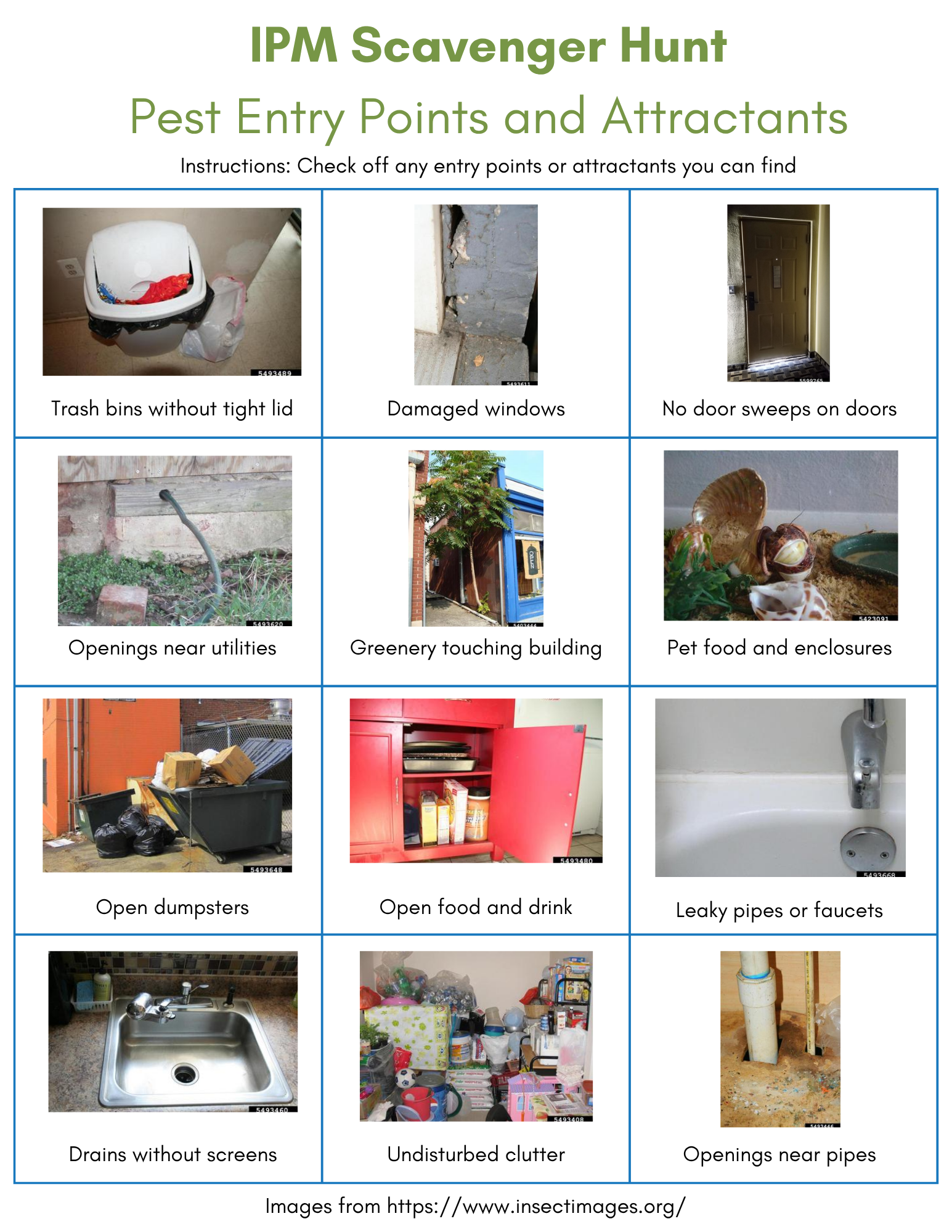
Click here to download the scavenger hunt: https://pestdefenseforhealthyschools.org/wp-content/uploads/2026/09/IPM-Scavenger-Hunt.pdf
Sources
Integrated Pest Management (IPM) Principles. EPA. (2026, July 22). https://www.epa.gov/safepestcontrol/integrated-pest-management-ipm-principles
Jacobs, S., Auman-Bauer, K., & Garling, L. (2025, November 11). Common Urban Pests: Identification, Prevention, and Control. Penn State Extension. https://extension.psu.edu/common-urban-pests-identification-prevention-and-control
Potter, M. F. (2026, March). How to Pest-Proof Your Home. Department of Entomology, Martin-Gatton College of Food, Agriculture, and Environment. https://entomology.mgcafe.uky.edu/ef641