
Managing Yellowjackets Around Schools
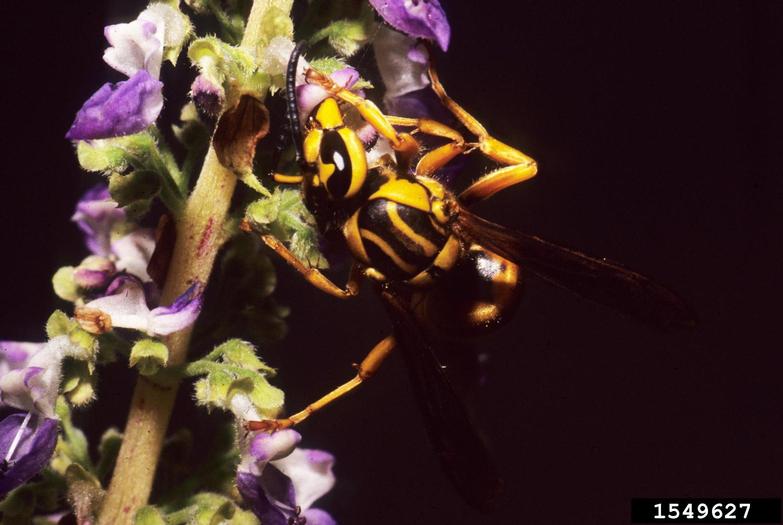
Photo by Jim Baker, North Carolina State University, Bugwood.org
Yellowjackets are primarily beneficial to the environment but are among the most concerning of the stinging insects. They are known to be easily provoked, sting multiple times and cause allergic reactions in some people (Northeastern IPM Center, n.d.). Populations peak around late summer, and schools should be prepared to manage this pest before the school year begins. Continue reading to learn about the differences between similar stinging insects, their life cycle, prevention and management.
Yellowjackets, hornets, and wasps are often confused with one another. They all belong to the Vespidae family which is composed of nearly 5,000 species. The Vespidae family is divided into the subfamilies of Vespinae (yellow jackets and hornets) and Polistinae (wasps). The Vespinae are split into the genera Vespula, Dolichovespula, and Vespa. Vespula are short-faced yellowjackets, Dolichovespula are long-faced yellow jackets, and Vespa are hornets. Species within the genera Vespula are the most concerning in North America (Oude Elberink, 2015). This includes the German yellowjacket (Vespula germanica), the eastern yellowjacket (Vespula maculifrons) and the western yellowjacket (Vespula pensylvanica) (Breece et al., 2018).
Correct identification of yellowjackets before implementing control measures ensures that other bees or wasps are not unnecessarily harmed. Yellowjackets are black with white or yellow markings, half an inch long, have wings folded lengthwise, have angular, thin bodies with a constricted waist and lack dense hairs. Most yellowjacket species make paper nests that are underground (Merchant et al., n.d.). If you find an aerial nest, it is more likely the aerial yellow jacket (Dolichovespula arenaria) or the bald-faced hornet (Dolichovespula maculata).
In the spring, the queen will begin to build a nest. Throughout the summer, she will produce many workers which will increase the size of the nest. Populations peak in late summer and early fall, and during this time the queen will lay eggs that become the next generation of queens. These new queens will mate before finding a place to overwinter in loose tree bark, roof shingles, or similarly protective places. The rest of the colony will decline in population, and the nest will disintegrate with the cold weather (Landolt & Antonelli, 2016).
School staff and students can prevent yellowjacket harborage by removing attractants. Attractants include food, water and shelter. Yellowjackets are scavengers and can be attracted to outdoor food and garbage. Keeping trash receptacles frequently cleaned and having tight-fitting lids can decrease attraction. Sealing holes and other openings in school buildings can decrease nesting sites (Merchant et al., n.d.).
Treating a yellowjacket nest can be dangerous and should be left to pest management professionals, but school staff and students can help report populations. Texas A&M AgriLife Extension suggests an action threshold of one complaint received or five or more wasps near food. If this is a prevalent pest, school buildings and grounds should be inspected monthly with careful attention to shrubbery, trees, eaves of buildings, fences, and wall voids. (Merchant et al., n.d.).
If yellowjackets are nearby, remain calm and avoid squashing them. When provoked, they will release a pheromone (a chemical that induces a social response in members of the same species) that will cause other yellowjackets to become aggressive. If yellowjackets begin to sting, cover your face and run indoors or to a shady area (Northeastern IPM Center, n.d.). For more guidance on stinging incidents, the Northeastern IPM Center provides guidelines for a sting response plan for schools.
Despite the concerns of stings, yellowjackets are generally beneficial insects. They serve as predators of insects that damage crops and trees and scavenge decaying plant and animal materials. Action shhttps://pestdefenseforhealthyschools.org/termites-in-schools/ould only be taken if yellowjacket stings are a threat (Breece et al., 2018). To learn about other school pests, see these blog posts from the Pest Defense for Healthy Schools:
- Mosquitoes: https://pestdefenseforhealthyschools.org/integrated-mosquito-management/
- Termites: https://pestdefenseforhealthyschools.org/termites-in-schools/
Sources
Breece, C., Wyns, D., & Sagili, R. (2018, July). Protecting Honeybees from Yellowjacket Wasps. Oregon State University Extension Service. https://extension.oregonstate.edu/sites/extd8/files/documents/em9211.pdf
Merchant, M., Pollet, D., Drlik, T., Olkowski, H., & Olkowski, W. (n.d.). IPM Action Plan for Yellowjackets – School Integrated Pest Management. Texas A&M AgriLife Extension. https://schoolipm.tamu.edu/forms/pest-management-plans/ipm-action-plan-for-yellowjackets/
Landolt, P. J., & Antonelli, A. L. (2016, July). Yellowjackets and Paper Wasps. Washington State University. https://s3.wp.wsu.edu/uploads/sites/1384/2016/07/Yellowjackets-and-Paper-Wasps.pdf
Northeastern IPM Center. (n.d.). Stinging Insects Guidance for the School Nurse. Northeastern IPM Center. https://schools.northeastipm.org/assets/file/school-nurses/Stinging-insects-in-schools-guidance.pdf
Oude Elberink, H. (Joanne) N. G. (2015). Insect sting allergy. Pediatric Allergy: Principles and Practice. https://doi.org/10.1016/b978-0-323-29875-9.00057-4
Western States Pediatric Environmental Health Specialty Unit at University of California-San Francisco. (n.d.). Integrated Pest Management: Yellowjackets. Western States Pediatric Environmental Health Specialty Unit at University of California-San Francisco. https://wspehsu.ucsf.edu/wp-content/uploads/2025/01/COMPLIANT_ipm_notes_healthsafetynotes-yellowjackets.pdf